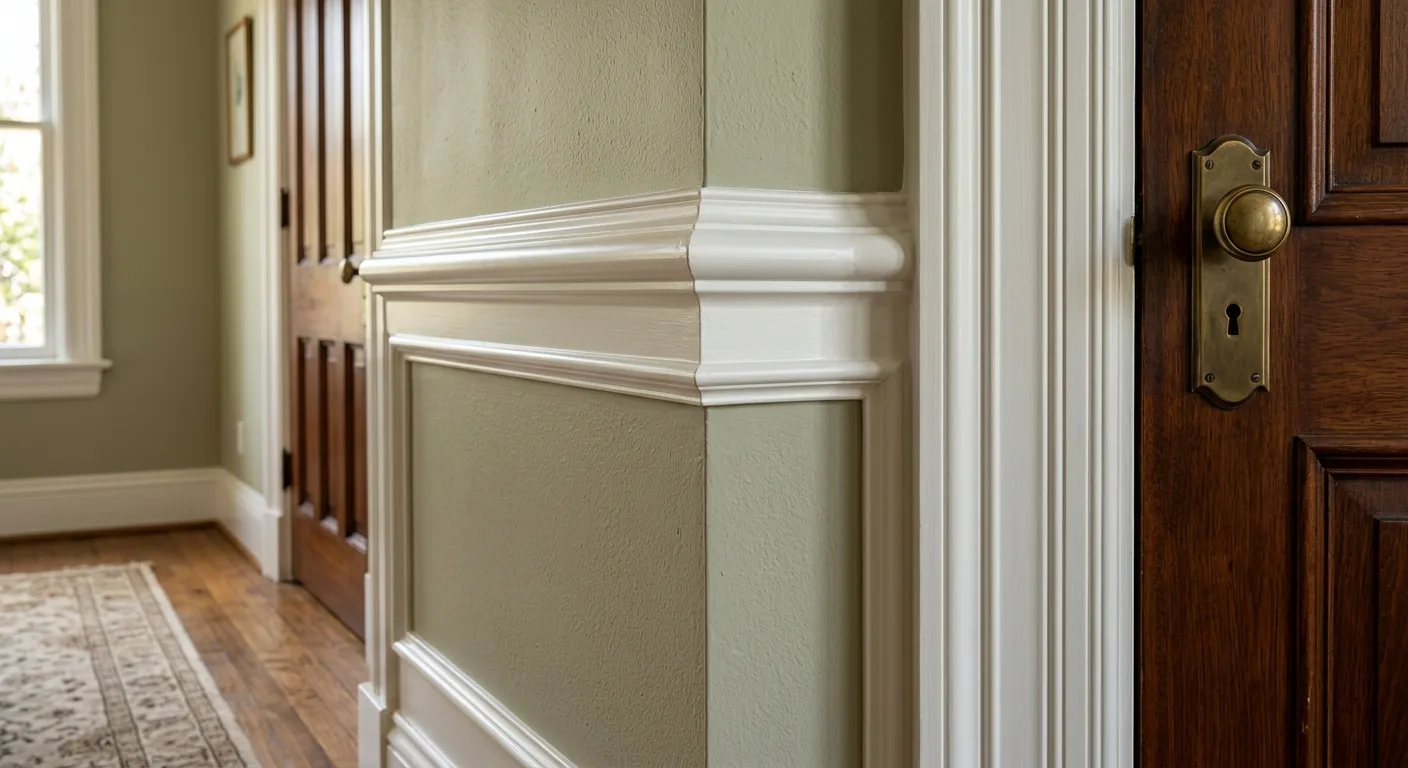
Family-owned · Austin Local
Molding Repair That Blends In, Not Out
From hairline cracks to dog-chewed door trim, we match the profile and finish so the repair disappears.
Free estimate
Tell us what you need
Three fields. It reaches a person here, not a call centre.
Molding Repair Done to Match
Cracked molding, separated corner joints, and chewed-up door trim are the kinds of damage homeowners notice every single day and never quite get around to fixing. Molding repair sounds like a small job, but the hard part isn't filling the gap. It's matching the profile, the texture, and the paint so the patch doesn't announce itself from across the room. At Hundredfold Services, that's exactly what we do. Call 318-348-4317 and we'll take a look at what you've got.
Every molding repair job starts with figuring out what you're actually working with. Crown molding, baseboard repair, door casing, window trim, plaster molding, MDF, finger-jointed pine. Each material behaves differently when you fill it, sand it, and paint it. A repair that works on painted MDF will look wrong on a plaster profile. Cost depends on the length of damaged section, how complex the profile is, whether we need to source a matching piece, and whether the wall behind it needs attention before we can close it up. We don't guess. We look at the job, tell you what it takes, and finish it so it holds. Every job is different. Contact Hundredfold Services for an accurate estimate.
What We Repair on Molding Jobs
Most molding damage falls into a handful of categories. Here's what we see most often.
- 01
Cracked and Split Profiles
Wood and MDF molding expands and contracts with the seasons. Hairline cracks along the face or at joints are common in older homes. We fill, re-sand to profile, and finish to match.
- 02
Chewed or Impact Damage
Dogs, doorknobs, moving furniture. If a section is too far gone to repair in place, we splice in a matching piece and feather the transition so it disappears.
- 03
Separated Caulk Lines and Corner Gaps
Inside corners and ceiling lines pull away over time. Re-caulking is a ten-minute job that most people do wrong. We clean out the old material, fill it properly, and tool it smooth.
- 04
Water-Damaged or Soft Sections
Water turns MDF to mush and rots pine from the inside. We remove the damaged section, address any wall or drywall repair behind it, and install a replacement piece that matches.
How It Works
Our Molding Repair Process
- 01
Assess and Match
We look at the profile, material, and finish before we touch anything. If we need to source a matching piece, we do that first. Rushing this step is why most molding repairs look like molding repairs.
- 02
Repair or Replace
Minor damage gets filled and shaped. Major damage gets cut out and spliced. Either way, the goal is a seam you can't find after paint.
- 03
Finish and Blend
Sand, prime, caulk the edges, and touch up the paint. We don't leave the finish work for you. That's the part that makes the repair invisible.
Know Before You Call
When to Repair vs. When to Replace

- Hairline cracks: repair
- Corner gaps and caulk failure: repair
- Localized chew or impact damage: repair or splice
- Water-logged material over 12 inches: replace
- Discontinued profile with no match available: replace
Fast Facts About Molding Repair
What homeowners most want to know, without the runaround.
Most repairs finish in a single visit
Filling, sanding, and caulking dry fast. If paint touch-up is needed, we carry common whites and neutrals. Complex color matching may need a second pass.
Profile matching is the hardest part
Big-box stores carry a few dozen profiles. Older homes often have custom or discontinued trim. We take a sample and find the closest match before we start cutting.
Paint adhesion depends on prep
Skipping primer on a patch is why repairs show through in a year. We prime every filled section before the topcoat goes on.
Dog damage is more common than you'd think
Puppies and door-frame corners are a predictable combination. A chewed section can be spliced cleanly. You don't have to re-trim the whole door.
Window trim repair follows the same steps
Repair window molding around casement or double-hung frames the same way we handle interior trim. The material is usually the same. The exposure to moisture is higher, so we use exterior-grade caulk at the sill.
Plaster molding needs different products
Filling a plaster profile with latex wood filler isn't wrong, but it shrinks more than setting-type compound. We use the right filler for the substrate so the repair doesn't telegraph itself six months later.
Molding Repairs That Don't Announce Themselves
- 01
Identify the material
Wood, MDF, plaster, and polyurethane each take filler, sanding, and paint differently. Getting this wrong at the start is how you end up with a visible patch.
- 02
Match the profile
We don't eyeball it. We take a cross-section reference or a physical sample to confirm the profile before we splice anything.
- 03
Finish the whole surface
Caulking, priming, and paint touch-up are part of the repair, not extras. A patch without a finish is a patch everyone can see.
Molding Repair Questions, Answered
How do I fix damaged molding that has a complex profile I can't match at the hardware store?
What's the best way to fill cracks in molding before painting?
Can dog-chewed door molding actually be repaired, or does the whole casing need to come off?
What causes crown molding to crack at the corners, and is it going to keep happening?
How do you repair window molding that's soft or swollen from moisture?
Can you match paint on a molding repair without repainting the whole wall?
Ready to Fix That Trim?
Small molding repairs don't have to stay on the list indefinitely.