Austin (318) 348-4317
Hudredfold Services
Deck Construction Contractors Who Build It to Last

Family-owned · Austin Local

Deck Construction Contractors Who Build It to Last

From framing and joists to the final board, we handle the full deck build so you don't have to manage five separate crews.

Free estimate

Tell us what you need

Three fields. It reaches a person here, not a call centre.

No obligation · Responds within 1 business day


By submitting this form you agree that we may contact you about your request and share your details with partner companies for marketing purposes.

Deck Construction Contractors Dallas Homeowners Call First

Hiring deck construction contractors is one of the bigger decisions you'll make as a homeowner, and the difference between a deck that holds up for fifteen years and one that starts warping by year three comes down to how the framing is built, not just how it looks on day one. Hundredfold Services builds decks from the ground up, handling everything from site prep and post setting to decking boards and finishing details. Dominique Willis runs every job personally, so when you call (318) 348-4317, you're talking to the person who shows up with the tools.

What drives the cost of a deck build? Size is the biggest factor, but it's not the only one. A 14x20 deck on flat grade with straightforward access costs meaningfully less than the same footprint on a sloped lot that needs deeper posts and more structural support. Material choice matters too: pressure-treated lumber is the workhorse option for most budgets, while composite decking runs higher upfront but cuts long-term maintenance down. A 20x20 deck can range widely depending on those variables, and any contractor who quotes a firm number before seeing your site is guessing. Every job is different, so contact Hundredfold Services for an accurate estimate.

The Build

What a Proper Deck Frame Actually Requires

The boards you walk on are the last thing we think about, not the first.
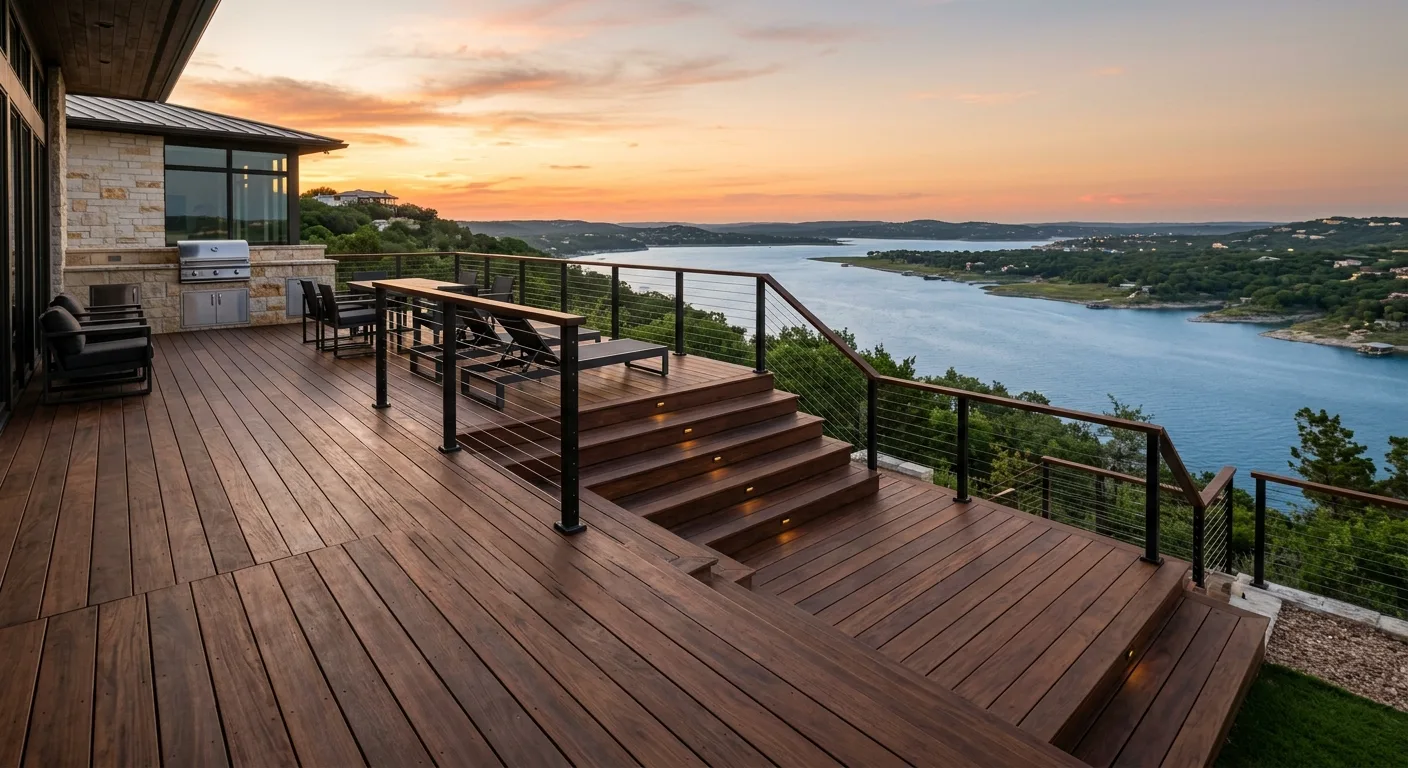
A deck starts underground. Post footings need to go below the frost line to stay stable through North Texas winters, and the ledger attachment to your house has to be bolted through the rim joist with proper flashing, not just lagged to siding. We use 2x10 joists on standard spans to keep flex out of the deck surface, and we don't skip the blocking between joists that prevents lateral movement over time. Honestly, a lot of decks you see failing at the ledger or showing bounce in the middle were framed with the minimum, and the minimum isn't enough. Staircase construction follows the same principle: the structure underneath is the job.
deck construction work, professional service in Austin, TX

Our Process

What the Build Process Looks Like

  1. 01

    Site Assessment and Layout

    We walk the site, confirm footing locations, check grade and drainage, and lay out the deck dimensions before a single hole is dug. This is where we catch problems that would cost you money later.

  2. 02

    Framing and Structure

    Posts, beams, joists, and blocking go in first. The ledger is attached to the house with proper hardware and flashing. Every structural connection is done before decking starts.

  3. 03

    Decking, Stairs, and Finish Details

    Boards go down with consistent spacing for drainage and expansion. Stairs, railings, and any trim or fascia work finish the job. We don't leave a site that looks half-done.

Materials

Pressure-Treated vs. Composite : Which One Fits Your Build

Pressure-treated lumber is what most decks in this area are built with, and for good reason: it's durable, widely available, and it takes stain and paint well once it's dried out. You'll need to seal it every few years, but the upfront cost is lower than composite. Composite decking, made from wood fiber and plastic, doesn't need sealing or staining and it won't splinter. The tradeoff is cost: composite materials run significantly higher per linear foot. Neither option is wrong. It depends on your budget, how much maintenance you want to do, and how long you plan to stay in the house. We'll lay out both options clearly so you can decide without any pressure.
deck construction work, professional service in Austin, TX

What's Included in a Full Deck Build

  1. 01

    Footing and Post Installation

    Concrete footings set below frost depth, with posts plumb and anchored correctly from the start.

  2. 02

    Beam and Joist Framing

    Structural framing with proper joist sizing, spacing, and blocking for a surface that won't flex or bounce.

  3. 03

    Ledger Attachment with Flashing

    Ledger bolted through the rim joist with approved hardware and flashing to keep water out of the wall assembly.

  4. 04

    Decking Boards, Stairs, and Railings

    Finish surfaces installed with consistent spacing, followed by stairs and code-compliant railings to complete the build.

When a Handyman Isn't the Right Call for a Deck

deck construction work, professional service in Austin, TX
Not every deck project is the same scope, and we're straightforward about what we take on. A full new deck build is a structural project: it involves load calculations, footing depths, and ledger connections that carry real weight. If you need a small platform deck, repairs to an existing structure, or boards replaced on a deck that's otherwise sound, that's a different conversation. We don't subcontract work out to a crew you've never met. Dominique shows up, does the work, and stands behind it. If a project is outside what we can deliver correctly, we'll tell you before you spend a dollar. For interior finish work once your deck project wraps up, trim repair and painting are available to close out the job clean.

Deck Questions We Hear Every Time

Do I need 2x8 or 2x10 joists for my deck?
It depends on your joist span. A 2x8 joist can carry a standard residential load over shorter spans, typically up to about 10 feet depending on species and spacing. Once your spans get longer or you're spacing joists at 16 inches on center over a larger deck, 2x10s give you the stiffness that keeps the deck from flexing underfoot. We size the joists to the actual span before framing starts, not after.
How much does a 14x20 deck cost to build?
A 14x20 deck is 280 square feet, which is a mid-sized residential build. The cost varies based on material choice, site conditions like slope and access, post depth required, and whether you're adding stairs or railings. Pressure-treated framing with composite or treated decking will land in different ranges. Every job is different, so contact Hundredfold Services for an accurate estimate.
How much would a 20x20 deck cost?
At 400 square feet, a 20x20 deck is a substantial structure that requires more footings, more framing material, and more labor than a smaller build. A flat lot with easy access costs less than a sloped yard that needs longer posts or stepped framing. Material grade, railing style, and whether you want stairs on one or two sides all move the number. Every job is different, so contact Hundredfold Services for an accurate estimate.
Do I need a permit to build a deck at my house?
Most jurisdictions require a permit for decks above a certain height or square footage, and that threshold varies by city. Some areas require stamped plans. Skipping a permit can create problems when you sell the house: unpermitted structures sometimes have to be removed or brought up to code at your expense. We discuss permit requirements with you before the build starts, not after.
How long does a wood deck last before it needs to be replaced?
A pressure-treated wood deck that's properly framed, sealed on schedule, and kept clear of debris can last 25 to 30 years in most climates. The first failure point is usually the ledger connection or where posts contact soil or concrete, not the decking boards themselves. Composite decking typically carries a manufacturer warranty of 25 years or more on the material, though the frame underneath is still subject to the same structural demands.
Can a deck be built on a sloped yard?
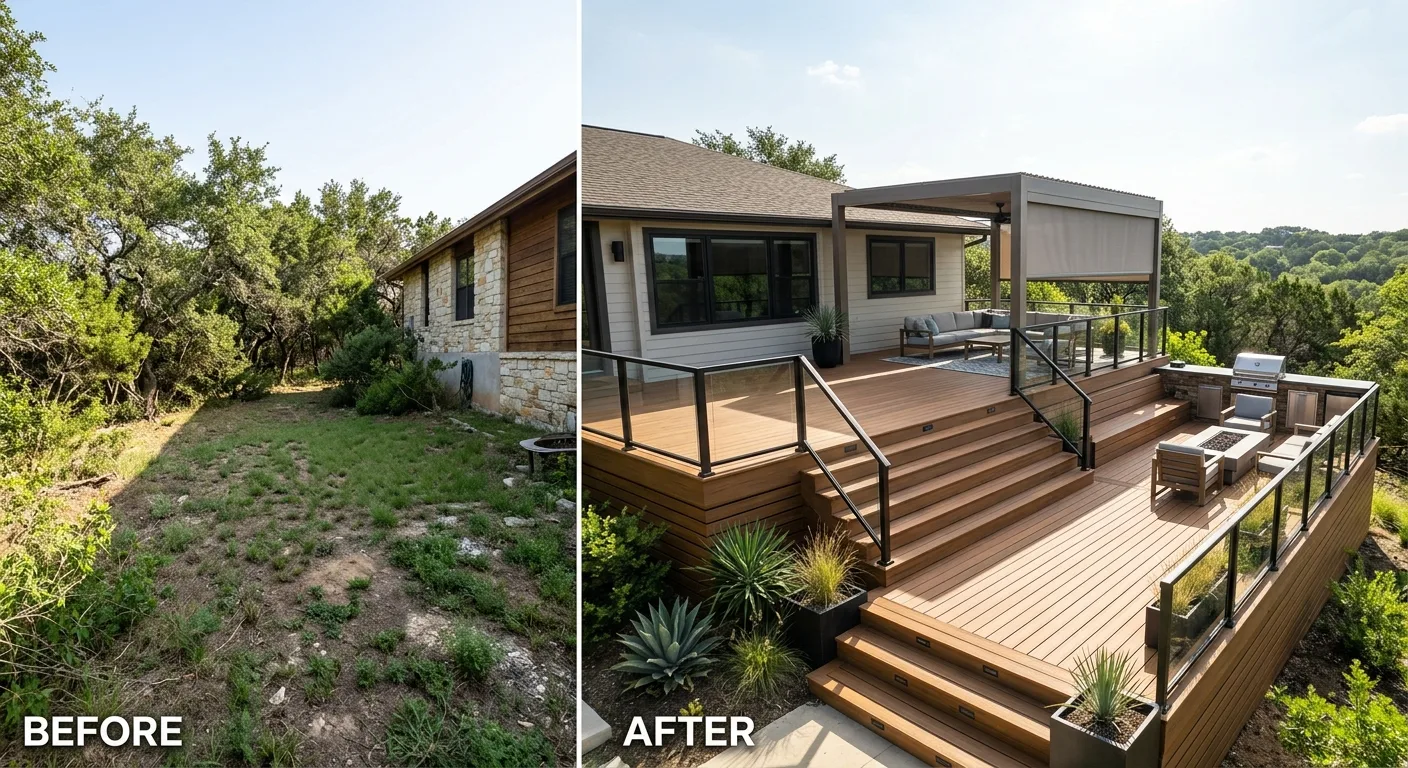
Yes, and sloped lots are common in this area. The framing approach changes: posts need to be longer to maintain a level deck surface, and depending on how steep the grade is, you may need a free-standing structure rather than a ledger-attached one. The cost goes up with slope because there's more material and more labor involved in getting everything level and properly anchored. We assess the grade before quoting anything.
How long does a pressure-treated wood deck last?
A pressure-treated wood deck that's properly framed, sealed on schedule, and kept clear of debris can last 25 to 30 years in most climates. The first failure point is usually the ledger connection or where posts contact soil or concrete, not the decking boards themselves. Composite decking typically carries a manufacturer warranty of 25 years or more on the material, though the frame underneath is still subject to the same structural demands.

Ready to Add Outdoor Space? Let's Talk About Your Deck.

Call Dominique directly and describe what you're thinking. You'll get a straight answer on scope, materials, and next steps, no runaround.

Related